
How to Build a Firewood Shed That Keeps Wood Dry
How to design and build a firewood shed: sizing by cord, airflow, roof and slatted sides, raised floors, foundations, materials and where to place it.
If you heat with wood, how you store it matters as much as what you burn. Wet or unseasoned wood is harder to light, gives less heat and produces more smoke and creosote in the chimney. A well-designed firewood shed protects the wood from rain and snow while letting air flow through the stack, so it dries and stays dry. It is also one of the simplest outdoor structures to build yourself.
What a firewood shed needs to do
A good woodshed has four jobs:
- Keep rain and snow off the top of the stack.
- Let air move through the wood on as many sides as possible.
- Keep the wood off the ground so it does not absorb moisture.
- Be easy to load and unload, ideally close to the house.
Unlike a storage shed, a woodshed should not be airtight. Solid walls and a closed door trap moisture; slatted sides and an open front let wood dry.
How much wood do you need to store?
Firewood is traditionally measured in cords. A full cord is a stack 4 feet high, 4 feet deep and 8 feet long: 128 cubic feet, or about 3.6 m3, including the air gaps between logs. A "face cord" or "rick" is a single row of logs 4 feet high and 8 feet long, so its volume depends on log length and is less than a full cord. In metric countries, wood is often sold by the stacked cubic metre, but local definitions vary, so always ask the seller what their unit means.
How much you burn in a season depends on your climate, the size and insulation of your home, your stove and how much you rely on wood. If you are unsure, look back at what you bought last year. Many people store one season's wood that is ready to burn and stack next season's wood separately to season.
Sizing the shed
Work out the volume you need, then choose dimensions:
- Depth: one log length plus some airflow space. Logs cut to about 16 inches (40 cm) suit many stoves, so a shed around 2 to 4 feet deep (60 to 120 cm) is common.
- Height: about 4 to 6 feet (1.2 to 1.8 m) of stack keeps loading comfortable and stable.
- Length: whatever you need to reach your target volume.
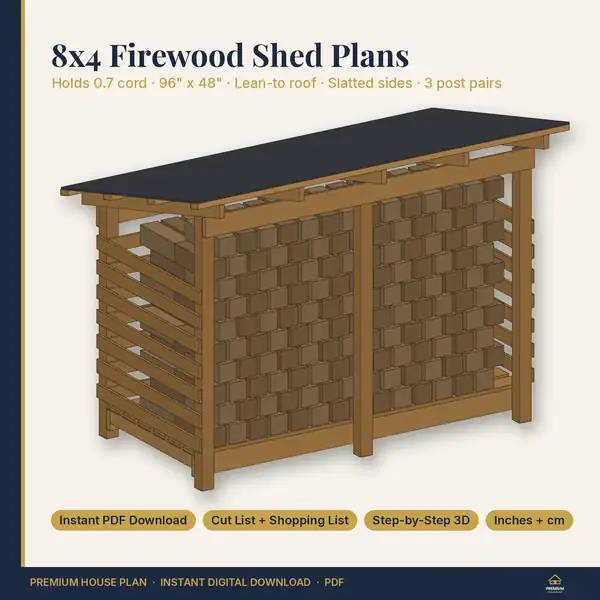
Our 8x4 firewood shed plan is sized at about 0.7 cord, a practical capacity for a compact garden woodshed.
Design features that help wood dry
Roof with overhang
A roof that overhangs the front and sides keeps driving rain off the stack. A lean-to (single slope) roof is the simplest and works well against a fence or wall; slope it away from the open front if possible, or add a generous front overhang. Corrugated metal, roofing felt on a sheathed deck, or shingles are all suitable.
Slatted or open sides
Leave gaps of a few centimetres between side and back boards, or use open framing. This lets air move through while giving some shelter from the wind and rain.
Raised floor
A slatted floor of treated timber, raised on joists or pallets, keeps logs out of standing water and lets air circulate underneath. Never stack firewood directly on soil.
Dividers
A central divider lets you separate seasoned wood that is ready to burn from fresh wood that is still drying, so you always use the driest wood first.
Foundation and materials
A firewood shed is light, but a full stack of wood is heavy. Common foundations include:
- concrete blocks or pavers on compacted gravel
- concrete piers on sloping ground
- ground screws for quick installation
Use pressure-treated timber or a naturally durable species for anything near the ground. Exterior-rated screws and fixings resist corrosion. A coat of exterior wood finish extends the life of the structure.
Where to put your woodshed
- Close enough to the house to carry wood easily in winter, but not against the house wall where stored wood can harbour insects and moisture.
- On a level, well-drained spot that gets sun and wind, which help drying.
- With the open side facing away from the prevailing wind and rain where possible.
- Clear of overhanging branches and accessible for deliveries.
Check local rules on outbuildings and on distances from boundaries, and follow fire safety guidance for storing fuel near buildings.
Seasoning: storage is only half the story
Freshly cut wood contains a lot of water. It needs time, sun and air to season before it burns well. Hardwoods generally take longer than softwoods, and split wood dries faster than whole rounds. An inexpensive moisture meter is the easiest way to check whether wood is ready; many stove manufacturers recommend burning wood below about 20% moisture content. Follow your stove manufacturer's guidance.
Building it yourself
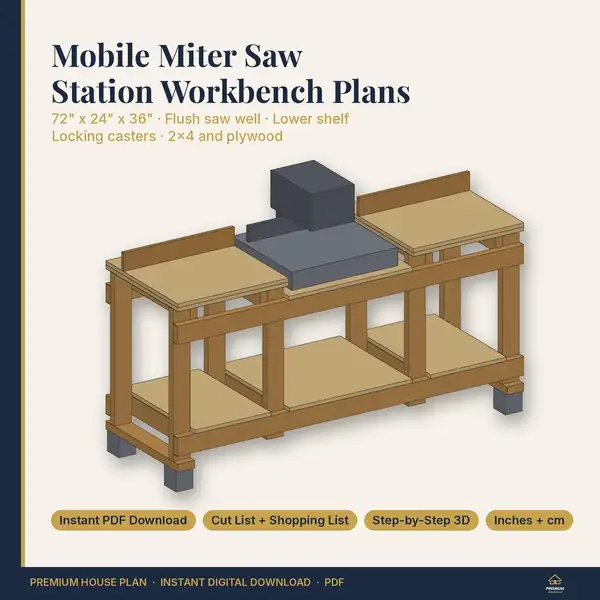
A simple woodshed is a good weekend project for a DIYer with basic tools: a saw, drill/driver, level, square and tape measure. The steps follow the same pattern as a garden shed: base, floor frame, posts or wall frames, roof structure, roof covering and slatted cladding. Our DIY shed building guide covers foundations, framing and roofing in more detail, and a stable workbench such as our mobile workbench plan makes cutting repeat parts quicker.
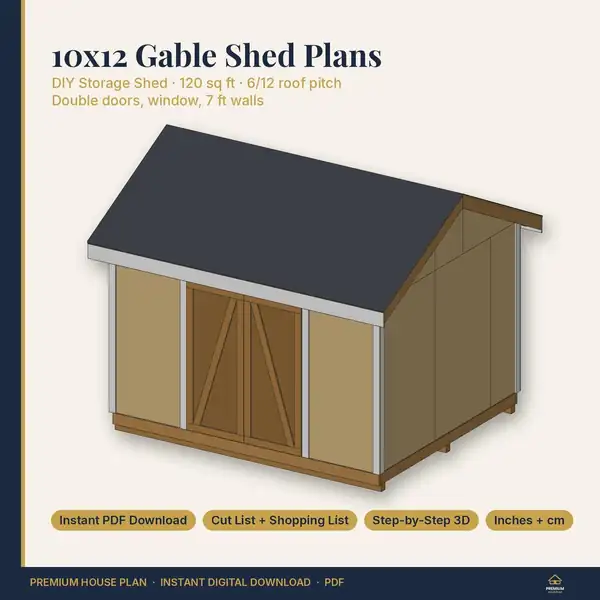
Our firewood shed plans are PDF plans with cut lists and shopping lists, with measurements in inches and cm. Browse firewood shed plans or, for general storage, our shed plans.
Plans with full cut lists Every plan page lists exactly which files are included and shows the price before you buy.
Browse firewood shed plans All plansFrequently asked questions
Should a firewood shed have walls?
Partial walls are best. Slatted sides and an open front protect the wood from rain while letting air flow through. Fully enclosed sheds trap moisture.
How big is a cord of wood?
A full cord is a stack 4 x 4 x 8 feet, or 128 cubic feet (about 3.6 m3), including air gaps. Face cords and metric units vary, so confirm with your supplier.
How long does firewood take to season?
It depends on species, how it is split and stacked, and the climate. Softwoods dry faster than hardwoods. A moisture meter tells you when the wood is ready.
Can I stack firewood against my house?
It is generally not recommended. Stacks against walls can trap moisture and attract insects. A separate woodshed a short distance away is better.
Related categories
Plans related to this guide
More guides
Metric vs Imperial House Plans: Units, Scales and Converting
Working with metric and imperial building plans: exact conversion factors for length and area, drawing scales, lumber sizes and common conversion mistakes.
DIY Shed Building: Foundation, Framing and Roofing
Build a garden shed yourself: choosing a size, permits, foundation options, floor and wall framing, roof types, cladding, doors and weatherproofing.
How to Choose a House Plan for Your Plot
A step-by-step checklist for matching a house plan to your land: setbacks, coverage limits, plot width, slope, orientation, access and budget.